One of the most common mistakes I see speakers make is starting with slides.
I get it. It feels productive. You’re organizing content, shaping bullet points, finding charts, building the visual flow. It looks like progress.
When you do this, your speech becomes a collection of interesting, yet disconnected, points. Your slides become a content prison that dictates your thinking. The result is an information dump where your speech becomes a sequence of information instead of a sequence of meaning. You end up explaining things clearly enough, but nothing actually lands.
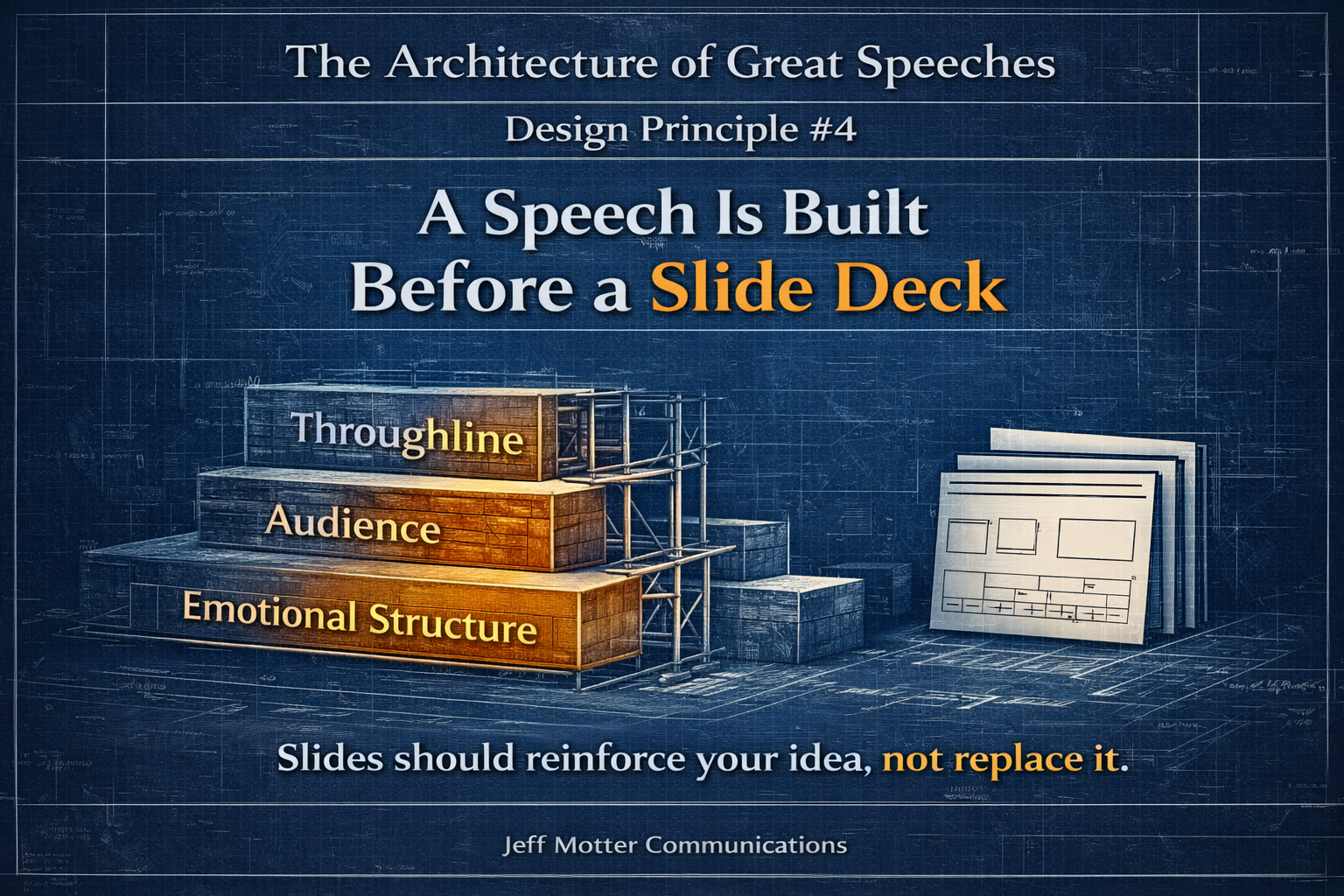
Because slides are never structure. They’re always reinforcement.
Structure lives somewhere deeper. It lives in the idea you’re trying to help the audience see. It lives in the throughline that carries them from where they are to somewhere new. And it lives in the emotional journey, those moments of recognition, tension, and insight that give any speech its momentum.
Those decisions must be made before a single slide is built.
I often think about this the same way I think about a bridge. Long before the steel is raised or the concrete is poured, the architecture already exists. The engineers know what the bridge must carry, where it begins, and where it ends. The materials come later. They serve the design.
Slides are the materials. They are not the architecture.
A great talk is built first in thought, in structure, in intention. Only after the crossing is designed do the visuals come in to support it. That’s how you make the path clearer, rather than becoming the path itself.
Slides should illuminate the journey. They should never replace it.