Most people hear “structure” and picture an outline. You know, the kind of outline that keeps any speaker from wandering aimlessly for what seems like an eternity. The audience already took the off ramp as you plowed ahead about how you “learned a powerful lesson” about B2B sales when confronted by a grizzly bear at a birthday party.
So, yes, structure is essential to keep you from rambling and going off course. It helps to structure a coherent message from the first to the last word. The question isn’t if structure matters but what kind.
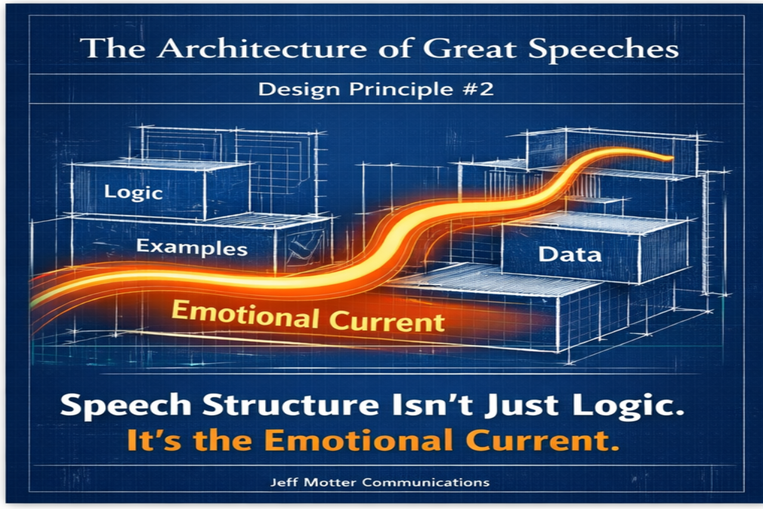
Because the structure that actually holds an audience isn’t just logical. It’s emotional. It’s the current underneath your words that decides whether people lean in, drift off, or start mentally exiting to think about their to-do list.
Because audiences don’t experience a talk as “Point 1, Point 2, Point 3.” They experience it as momentum. Even very smart listeners are constantly asking, albeit quietly, politely, and with skepticism: Why does this matter? Where is this going? And am I safe here?
Emotional structure answers those questions without you having to stop and announce, “Now we will be arriving at the section where this becomes relevant.” The emotional structure transforms your speech from a list of things you think the audience needs to know to a movement and flow that places the audience at the center of the story.
So when you’re shaping a speech, don’t merely ask, “Does this argument make sense?”
Ask instead, “What does it feel like for the audience to follow this?” What emotions do the audience need to feel to move them from where they are to where you want them to be? What is the final feeling I want them to leave with? And how do I get them there?
At the end of your talk, you can present information or you can present a mirror that allows the audience to think about themselves in the context of your talk.
And if you can do this … your message doesn’t just land. It lands with witnesses.