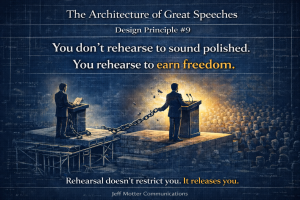
A lot of speakers avoid rehearsal because they want to “keep it natural.” Sure, “natural” is great. But you don’t get natural by improvising your way through important moments. You get natural by rehearsing until your brain stops panicking and starts communicating. With feeling.
Rehearsal isn’t memorizing every word. In fact, it’s a terrible idea to memorize a speech word for word. Instead, you learn your talk by building muscle memory around the shape of it. Your opening, your transitions, your key turns, your close. Those are the moments where people get lost or pulled forward. If you own those, you can be fully present without losing the thread.
This is also why “just know your material” is not enough. You can know the material and still deliver it like a Wikipedia entry. What the audience needs is a guided experience. That requires practicing out loud so you can hear what’s clunky, feel where you rush, and notice where a pause would do more work than another sentence.
The weird paradox is that rehearsal doesn’t make you robotic. It makes you available. When you’ve earned the structure, you can relax inside it. And when you relax, the audience does too.