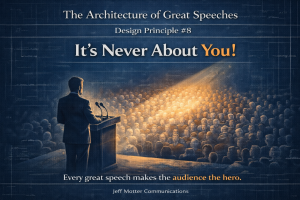
Most speakers step onto a stage with an unspoken assumption: this speech is about me.
And that instinct makes sense because you were invited to speak. After all, it’s my story and my experience. I’m the one holding the mic and the one who prepared! I’m the one standing under the lights, not them. Again, this assumption is understandable, but it’s also the moment many otherwise strong talks lose their influence.
When a speech is built around the speaker, the audience has very little room to step into that story. Yes, they listen politely, sometimes even attentively. At the end of your talk they’ll even come up to tell you what a good speaker you are, as if they are observing a 10-year old’s piano recital. When that happens, the narrative is already complete. The meaning has already been assigned. There’s nothing left for your audience to do except nod along and move on.
What’s missing isn’t information. What’s missing is room for the audience to do something with what you’re saying.
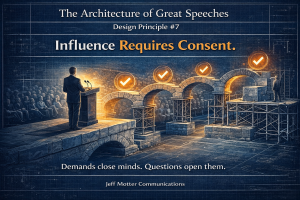
Influence requires space. It requires pauses where the audience can ask themselves how this idea collides with their own life, their own work, and their own decisions. When every example, insight, and conclusion points back to the speaker, that space disappears. The talk becomes a closed loop rather than an invitation. And the invitation makes all the difference.
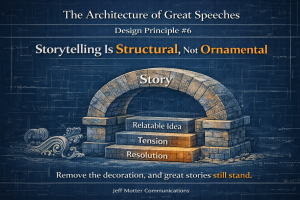
This is why most of the greatest speeches ever given aren’t organized around the speaker at all. They’re organized around an idea that needs room to breathe and move. There must always be room for the audience to wrestle with what you’re saying. To test it and make it their own. Yes, the speaker is present, but it’s a service role. Not as the hero of the story, but as its guide. Don’t even get me started on the Hero’s Journey formula … And if you want to hear more about that, just ask.
When you speak for yourself, you may be understood. But what you’ll never do is influence others to think or act differently than they already are. The audience has agency. And, in the words of one of my favorite authors, “We mustn’t take people for fools.”