As a speaker, this is one of the most important things to hear: your audience is not a receptacle into which you pour information. It doesn’t matter if it’s a presentation or conversation with your closest friends. Communication just doesn’t work like that, yet so many of us act like it does.
The person in front of you is not there to be filled with your wisdom. They’re humans who are busy, smart, and distracted. Each of us has our own opinions, histories, incentives, and wounds. So every word that enters their minds will be filtered through the stuff of life.
Which is exactly why their agency matters.
The moment you approach an audience as something you can control. Or even something you can “win,” “handle,” or “convince,” that’s when your language tightens. You start performing certainty. You start preaching. You start trying to close every gap of possible interpretations, as if you can deliver the message in a hermetically sealed container ready to be dumped perfectly into someone’s mind.
But audiences don’t receive meaning. They make meaning. They decide what your ideas mean for their lives, their teams, their choices. And the difference between a forgettable talk and an influential one is whether you leave room for that meaning-making to happen.
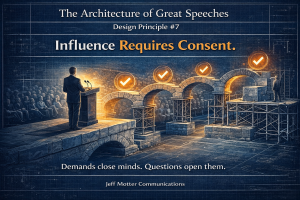
When you respect agency, you stop speaking at people and start building an invitation. You ask better questions. You name tensions instead of issuing commands. You give them enough clarity to understand you, yet allow enough space to imagine themselves inside the idea.
That’s how influence works. Because the goal isn’t to overpower an audience. The goal is to help them choose.
And when someone chooses the meaning themselves, it doesn’t just land. It lasts.